Distributed Consistency
Maintaining cache consistency across multiple nodes is one of the hardest problems in distributed systems. Zoocache addresses this using Hybrid Logical Clocks (HLC) and a "passive sync" mechanism.
Hybrid Logical Clocks (HLC)
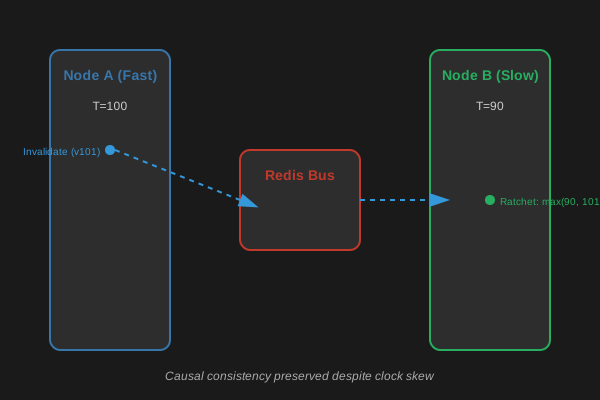
Standard system clocks (wall clocks) can drift. If Node A's clock is 5 seconds ahead of Node B, invalidations might be applied in the "wrong order" logically.
HLC combines the wall clock with a logical counter to ensure: - Causality: If Event B happens after Event A, B's HLC is guaranteed to be greater than A's. - Monotonicity: Clocks never move backward.
Distributed Invalidation Flow
- Node A invalidates a tag. It calculates a new HLC version.
- Node A publishes
tag|versionto the Redis Bus. - Node B receives the message and updates its internal Trie only if the incoming version is greater than its local version (Ratchet).
Passive Resync (Self-Healing)
What if the Redis Pub/Sub message is lost? Zoocache implements Passive Resync: - Every cached entry in the storage (Redis or LMDB) contains the version snapshot of its dependencies. - When Node B reads an entry written by Node A, it extracts the versions from the entry. - If these versions are newer than what Node B has in its local Trie, Node B catches up automatically.
This ensures that nodes eventually consistent themselves just by reading data, even without the message bus.
Trade-offs & Considerations
- Eventual Consistency: While HLC and Passive Resync are robust, there is still a tiny window of "stale" hits if the Bus message is delayed and no other read triggers a resync.
- Redis Dependency: For distributed mode, a Redis-compatible bus is required. Without it, nodes operate in "local-only" mode.