Serialization & Compression
To achieve high throughput and low latency, Zoocache implements a specialized serialization pipeline in Rust.
The Pipeline
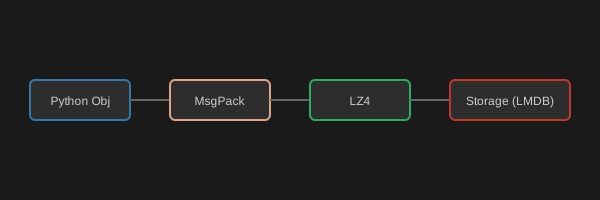
1. MsgPack
We use MessagePack as the intermediate representation. It is more compact than JSON and faster to parse than Pickle for many common data structures.
2. LZ4 Compression
Before writing to the storage backend (LMDB, Redis, or RAM), data is compressed using LZ4. - Why LZ4?: It offers a very high decompression speed, which is critical for cache performance, while still providing decent compression ratios for JSON-like data.
3. "Zero-Bridge" Transcoding
To minimize FFI overhead, we use direct streaming transcoding:
- Write: Python Object -> Depythonizer -> Transcoder -> MsgPack Serializer -> Bytes
- Read: Bytes -> MsgPack Deserializer -> Transcoder -> pythonize -> Python Object
This completely eliminates intermediate serde_json::Value or manual Rust struct allocations, making the Python-Rust boundary near-zero cost.
Trade-offs & Considerations
- Compatibility: We use
pythonize/depythonize, which handles most standard Python types (dicts, lists, int, str, float, bool). However, custom classes or complex objects that aren't JSON-serializable might require custom handlers or won't work out of the box. - Compression Overhead: LZ4 is fast, but for very small objects (e.g., a simple integer), the compression step might actually add a few nanoseconds of overhead that doesn't pay off in space savings.